
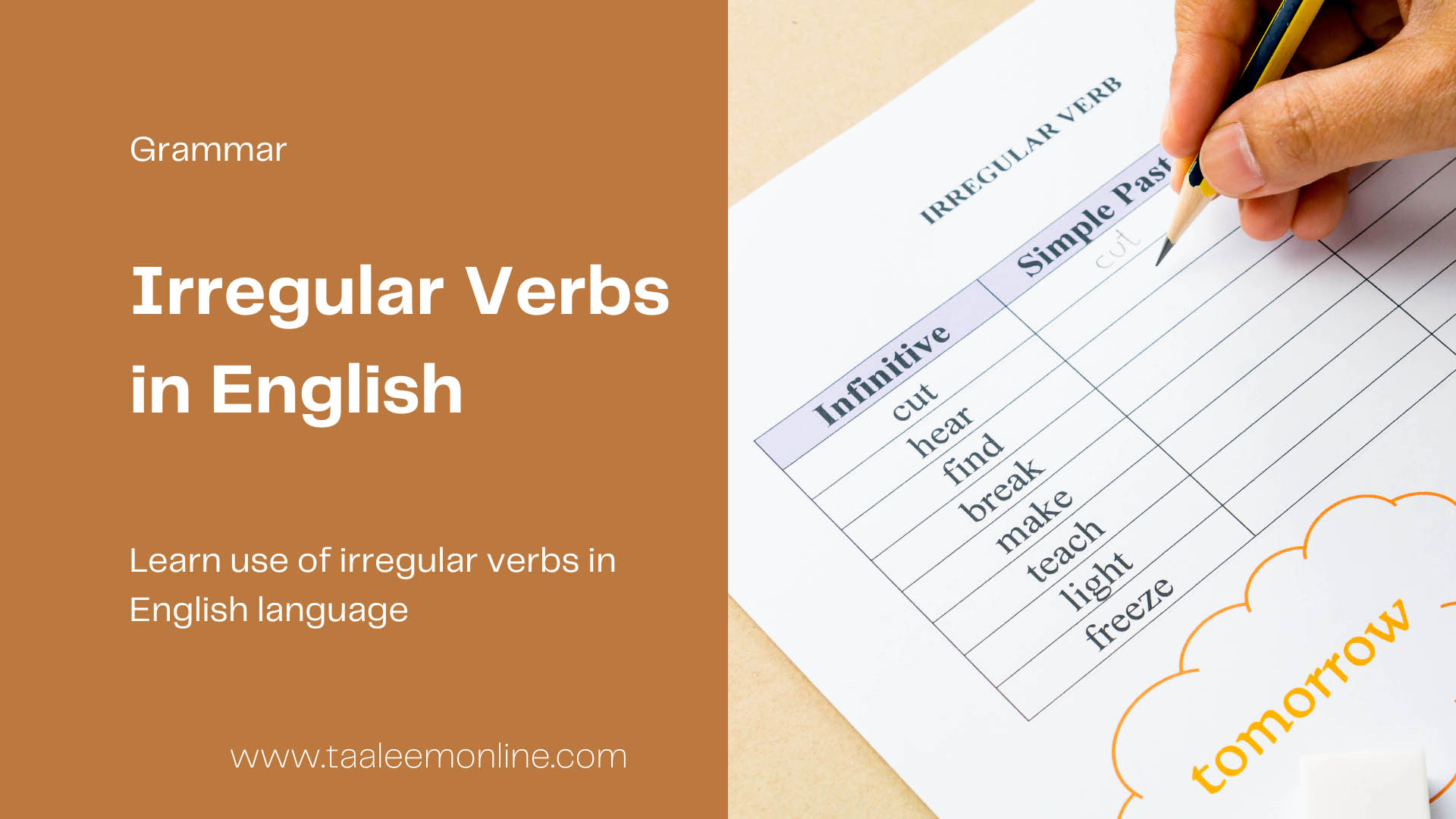
Irregular verbs are commonly used in the English language because they are among the most common verbs of English and are essential for improving your language skills. However, beginners often get confused when using their past and past participle forms in sentences.
In this article, you will learn what irregular verbs are, why they are important, and how to use them correctly in the present, past, and future tenses. You will also learn how to use them in your daily communication with practical examples.
Irregular verbs are verbs in English that do not follow the usual or regular pattern of inflection when used in the past and past participle. This means that we can not use -d or -ed at the end of the base form to make their past and past participle forms. In other words, irregular verbs do not require “d” or “ed” at the end of the base form to make their past and past participle forms.
Below are some examples of irregular verbs for your reference, in which you can see their base form along with past and participle forms.
| Base Form | Past Simple | Past Participle |
|---|---|---|
| put | put | put |
| cut | cut | cut |
| begin | began | begun |
| steel | stole | stolen |
| sleep | slept | slept |
Why Should You Learn Irregular Verbs?
Verbs are an essential part of speech in English grammar. In English, every sentence needs a verb to become a complete sentence. In other words, a sentence is not complete without a verb. That is why verbs are important in the English language. They describe actions and states of being in the sentences. Verbs tell us what is going on in the sentence.
For example:
- He goes to school.
- She writes a letter.
- They take tea.
Verbs are divided into two main types: regular and irregular. This division is based on the pattern they follow when making their past and past participle forms.
Regular verbs typically end with the letters “d” or “ed” in their past and past participle forms. It means that you can change the base form of a regular verb into its past and participle form by adding “-d” or “-ed” at the end. However, irregular verbs do not follow the same pattern when we make their past and past participle forms.
Like regular verbs, irregular verbs are also essential because they are frequently used in daily communication. Look at the following everyday life examples when we use them in English.
Examples:
- I wake up early in the morning.
- He runs fast.
- I eat food.
- He reads a newspaper.
- She writes a letter.
In these examples, we used irregular verbs: wake, run, eat, read, and write. Their past and past participle forms are different, and they do not follow the rule of adding -d or -ed at the end of the base form.
Types of irregular verbs
Irregular verbs are further divided into four groups based on the pattern in which they change their past and past participle forms. Let’s explore each one of them with examples!
1. Irregular verbs that change their forms in the Past and Past Participle
In this group, all three forms of irregular verbs have different spellings and pronunciations, meaning their base form, past simple form, and past participle form differ in both spelling and pronunciation.
Here, keep in mind that the past participle form is the third form of the verb, often used in perfect tenses and passive voice sentences.
Here are some examples of irregular verbs with all three different forms:
| Present | Past | Past Participle |
|---|---|---|
| begin | began | begun |
| bear | bore | borne |
| awake | awoke | awoken |
| drink | drank | drunk |
| arise | arose | arisen |
| fall | fell | fallen |
| go | went | gone |
| see | saw | seen |
2. Irregular verbs that only change their form in Past Tense.
In this group of irregular verbs, the base form and past participle form remain the same; however, only the past simple form (also known as the second form of a verb) changes in spelling and pronunciation.
See the examples below!
| Present | Past | Past Participle |
|---|---|---|
| run | ran | run |
| come | came | come |
| become | became | become |
3. Irregular verbs that remain same in 1st, 2nd, and 3rd forms
In this group, all three forms of the verb remain the same in spelling, and they are mostly pronounced the same. So, when these verbs are used in present, past, and future tenses, their spelling remains the same.
For example:
- He cuts the tree.
- He cut the tree yesterday.
- He will cut the tree tomorrow.
Here, you see that the verb “cut” remains the same in present, past, and future verb tenses.
Here are some more examples:
| Present | Past | Past Participle |
|---|---|---|
| cut | cut | cut |
| put | put | put |
| cost | cost | cost |
| let | let | let |
| shut | shut | shut |
| hit | hit | hit |
However, sometimes we use irregular verbs with the exact spelling, but we pronounce their second form differently. For example, when we use the verb “read” in the past tense, we read it as “Red.”
Examples:
- He read a newspaper.
- He read a newspaper. (pronounce as “red”, not “read”)
- He will read a newspaper.
4. Irregular verbs that remain the same in past and past participle
This group of irregular verbs includes verbs whose past and past participle forms are the same. which means their spelling and pronunciation are the same.
Examples
| Base Form | Past Simple | Past Participle | ||
|---|---|---|---|---|
| sit | sat | sat | ||
| buy | bought | bought | ||
| bring | brought | brought | ||
| think | thought | thought | ||
| sell | sold | sold | ||
| win | won | won | ||
| say | said | said | ||
| hear | heard | heard |
How to Use Irregular Verbs Correctly
Irregular verbs could be challenging for language learners. However, the best part is that you need to memorize them because these types of verbs don’t follow the pattern of regular verbs in which we just add -d or -ed at the end of the base form to make their past simple and past participle.
With that said, one of the best ways to memorize them is to use these verbs in your daily speaking and writing practice. Once you practice them in sentences and your writing exercises, you will get familiar with their different forms, pronunciation, and spellings.
Keep in mind that the past participle form is used in perfect tenses and passive voice sentences.
Examples
- He reads a newspaper.
- She wrote an essay.
- The store sells fruit and vegetables.
- He won the match.
- It costs too much.
- He shut the door.
- She puts her shoes on.
Conclusion
Irregular verbs are verbs in English grammar that do not follow the similar pattern of regular verbs while using them in present, past, and past particle forms. Their past and past participle forms can not be formed by just adding -d or -ed to the base form.
Therefore, learning the correct use of irregular verbs is not only useful but also a significant part of your proper communication skills in English. Memorizing and using irregular verbs in your communication is the best method to learn them.
I hope this article helped you to learn what irregular verbs are, their types, and how to use them correctly in English.
If you liked this article, then please subscribe to our newsletter for more articles on grammar, vocabulary, and language learning.
You can also follow us on Facebook, Instagram, and YouTube for the latest updates.
Related Posts
- What Are Impersonal Verbs? A Simple Explanation with Examples
- Transitive Verbs: Definition, Rules & Examples
- Verbs Followed by Infinitive
- What are Causative Verbs, and How to Use them?
- What are Stative Verbs in English Grammar?
- Verbs Followed by Gerunds with Examples
- List of Irregular Verbs in English
- List of Regular Verbs in English
- What is an Infinitive?
- What is the Past Participle?